
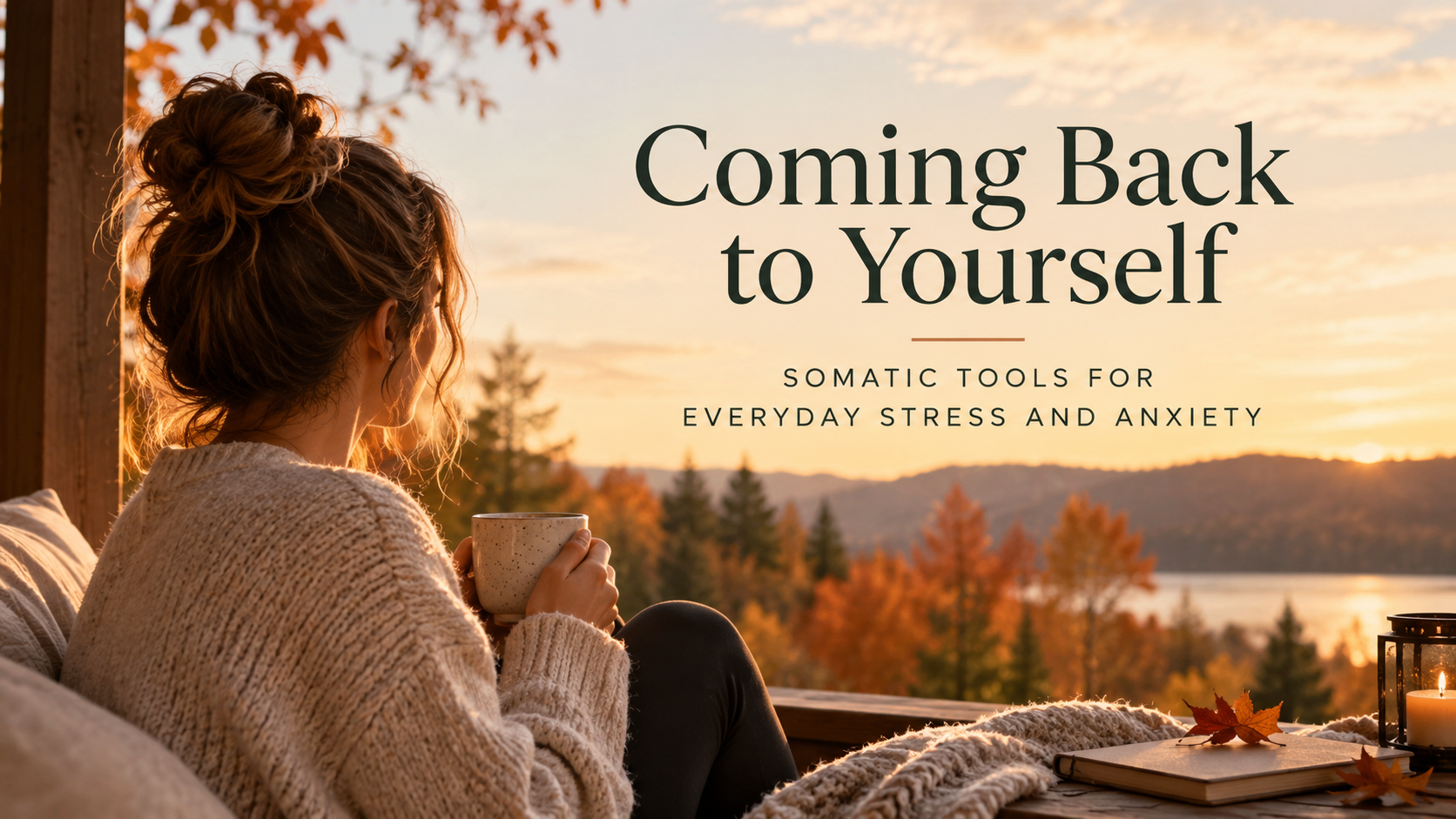
Coming Back to Yourself: Somatic Tools for Everyday Stress and Anxiety
Coming Back to Yourself: Somatic Tools for Everyday Stress and Anxiety
Sometimes, nothing is technically wrong.
And yet, your body feels like something is.
There are bills sitting on the counter. You're wondering if you have enough money this month. Something feels off in your relationship. Your child is struggling. Work has been relentless. There are messages you haven't answered and things you haven't gotten around to doing.
And now the days are getting shorter.
The light is changing. The mornings are cooler. Darkness comes a little earlier. Summer is disappearing, and suddenly everything feels just a little different.
Maybe you've noticed that you're more tired. More emotional. More restless. Or maybe you can't really explain what you're feeling at all.
You just know that you're carrying a lot.
And sometimes, when we're carrying a lot, we try to think our way out of it.
We tell ourselves:
Stop worrying.
Everything is fine.
Other people have it worse.
I just need to get myself together.
But your body doesn't always respond to logic.
Sometimes, your body needs to be included in the conversation.
What Does Your Nervous System Have to Do With It?
Our nervous system is constantly taking in information.
It notices what is happening around us and inside us. When we feel stressed or threatened, our body can move into a stress response. Our heart may beat faster. Our breathing may change. Our muscles may tighten. We may feel restless, irritated, overwhelmed, disconnected, or unable to concentrate.
This response is useful when we actually need to protect ourselves.
The problem is that modern stress doesn't always have a clear beginning and end.
There isn't necessarily a tiger chasing us.
There is a mortgage.
An unanswered text.
A difficult conversation we've been avoiding.
A child we're worried about.
A job we don't know if we can keep doing.
A relationship we're not sure about.
Ten emails waiting for a response.
And sometimes, it's simply too many small things happening at once.
The body can carry all of that.
This is where somatic tools can help.
Somatic simply means relating to the body.
Instead of only asking, "What am I thinking?" we also begin asking:
What is happening in my body right now?
And then we work with the body rather than against it.
The goal isn't to force ourselves to calm down.
It's to help ourselves come back.
1. Look Around You
This is one of the simplest things you can do.
Slowly look around the space you're in.
Don't rush.
Let your eyes actually notice your surroundings.
Maybe you notice the sunlight coming through the window.
A plant.
The colour of the wall.
Your dog sleeping nearby.
A cup sitting on the table.
A tree moving outside.
You can quietly name a few things you see.
I'm sitting in my living room.
The window is open.
I can hear birds outside.
My feet are on the floor.
This can help bring your attention away from everything that might happen and back to what is happening right now.
You don't have to convince yourself that everything will be okay.
For a moment, you're simply noticing:
I am here.
2. Let Your Exhale Be a Little Longer
When we're anxious, we're often told:
Take a deep breath.
But forcing ourselves to take enormous breaths can sometimes feel uncomfortable, especially when we're already anxious.
Try something gentler.
Breathe in comfortably.
Then let your exhale last just a little longer than your inhale.
No complicated counting is necessary.
Don't force it.
Just breathe in...
and slowly let the breath go.
Then again.
Research on relaxation techniques suggests that slow, intentional breathing can help support the body's relaxation response.
But this isn't about making anxiety disappear in thirty seconds.
Think of it as giving your body a small message:
You don't have to solve everything in this exact moment.
3. Give the Stress Somewhere to Go
Sometimes we don't need stillness.
We need movement.
If your body feels restless, tense, angry, or full of nervous energy, sitting quietly and trying to meditate might be the last thing you want to do.
So don't.
Stand up.
Walk around the block.
Stretch.
Shake out your hands.
Roll your shoulders.
Put on one song and move around your kitchen.
Or try pushing your hands firmly against a wall for a few seconds and then releasing.
Notice what happens when you stop asking your body to be calm and give it permission to move instead.
Sometimes movement comes before stillness.
4. Use Your Senses to Come Back
Your senses are always available to you.
And they can become simple anchors to the present moment.
Hold a warm cup of coffee or tea and actually notice the warmth in your hands.
Step outside and feel the cool air against your face.
Notice the smell after it rains.
Take a warm shower and pay attention to the feeling of the water.
Wrap yourself in a blanket and notice its weight and texture.
Listen to a song without doing anything else at the same time.
You don't need to turn any of this into a formal "practice."
You're simply giving your attention to something that is happening here instead of somewhere in the future.
5. Find the 5% That Feels Okay
I love this one because sometimes asking ourselves to feel completely safe or calm is simply asking too much.
Imagine you're worried about money.
Your chest feels tight.
Your stomach is turning.
Your brain has already calculated seventeen different disasters that haven't happened.
Someone telling you to relax probably isn't going to help.
Instead, ask:
Is there anywhere in my body that feels even 5% okay right now?
Maybe your hands feel okay.
Maybe your feet feel warm.
Maybe your back feels supported by the chair.
Maybe your jaw can soften just slightly.
Maybe the blanket across your legs feels comforting.
You don't have to find peace everywhere.
Find it somewhere.
And stay there for a few seconds.
Sometimes 5% is enough.
6. Ask Yourself What You Need Right Now
We spend a lot of time asking:
What's wrong with me?
Try replacing that question with:
What do I need right now?
The answer might be surprisingly simple.
Food.
Water.
Movement.
Rest.
A shower.
Fresh air.
Ten minutes without your phone.
A hug.
A conversation you've been avoiding.
Someone to listen without trying to fix anything.
Or maybe you don't know yet.
That's okay too.
Learning to notice what we need is part of learning to reconnect with ourselves.
And Then Fall Arrives
There is something interesting about this time of year.
The days become shorter. The temperature changes. We spend less time outside. Our routines change.
For some people, reduced daylight during fall and winter can affect mood, energy, sleep, and the body's natural daily rhythms. Seasonal Affective Disorder is a more serious form of seasonal depression, but even people who don't experience SAD may notice that they feel different as the seasons change.
So perhaps this is a good time to pay a little more attention to ourselves.
And nature gives us plenty of ways to do that.
Feel the cold air on your face.
Listen to the leaves under your feet.
Notice how the trees are changing.
Wrap your hands around something warm.
Open the curtains when the morning light comes in.
Go outside for a few minutes instead of spending the entire day moving from one screen to another.
Let the season remind you to notice your surroundings again.
Nature doesn't stay the same all year.
And neither do we.
Maybe we don't need exactly the same things in October that we needed in July.
Maybe our bodies are asking us to pay attention.
You Don't Have to Get Rid of the Feeling
I think this might be the most important part.
The purpose of these tools isn't to become someone who never feels anxious, overwhelmed, sad, angry, or afraid.
That isn't realistic.
And it isn't particularly human.
Regulation doesn't mean never becoming dysregulated.
It means slowly developing ways of finding ourselves again when life pulls us away.
Sometimes you'll take a walk and still be worried about money afterward.
Sometimes you'll breathe slowly and the relationship will still be uncertain.
Sometimes you'll hold your warm cup of tea and your job will still be stressful.
The problem doesn't magically disappear.
But perhaps you become a little more present while you're facing it.
And from that place, the next step may become easier to see.
Coming Back to Yourself
The next time you notice your shoulders creeping toward your ears...
or your thoughts jumping ten steps into the future...
or your body telling you that something feels like too much...
you don't have to immediately fix yourself.
Start smaller.
Look around.
Feel your feet.
Move your body.
Notice the air.
Take one slower breath.
Find the 5% that feels okay.
And remind yourself:
I notice you're overwhelmed.
I'm here.
Let's come back to this moment together.
Sometimes, that's enough for now.
Slow down. Reconnect. Grow.
A Gentle Note
Somatic and relaxation practices can be useful tools for everyday stress and anxiety, but they aren't a replacement for medical or mental health care. If anxiety, low mood, panic, sleep problems, or seasonal changes are persistent, severe, or interfering with your everyday life, consider speaking with a qualified health professional.
References & Further Reading
National Center for Complementary and Integrative Health (NCCIH). Relaxation Techniques: What You Need to Know. NCCIH describes breathing exercises, progressive muscle relaxation, guided imagery, and other relaxation practices, and reviews the evidence surrounding their use for stress and anxiety.
National Center for Complementary and Integrative Health (NCCIH). Mind and Body Approaches for Stress and Anxiety: What the Science Says. An overview of current evidence on relaxation techniques and other mind-body approaches for stress and anxiety.
National Institute of Mental Health (NIMH). Seasonal Affective Disorder. Information on seasonal changes in mood, daylight, sleep-wake rhythms, and Seasonal Affective Disorder.